
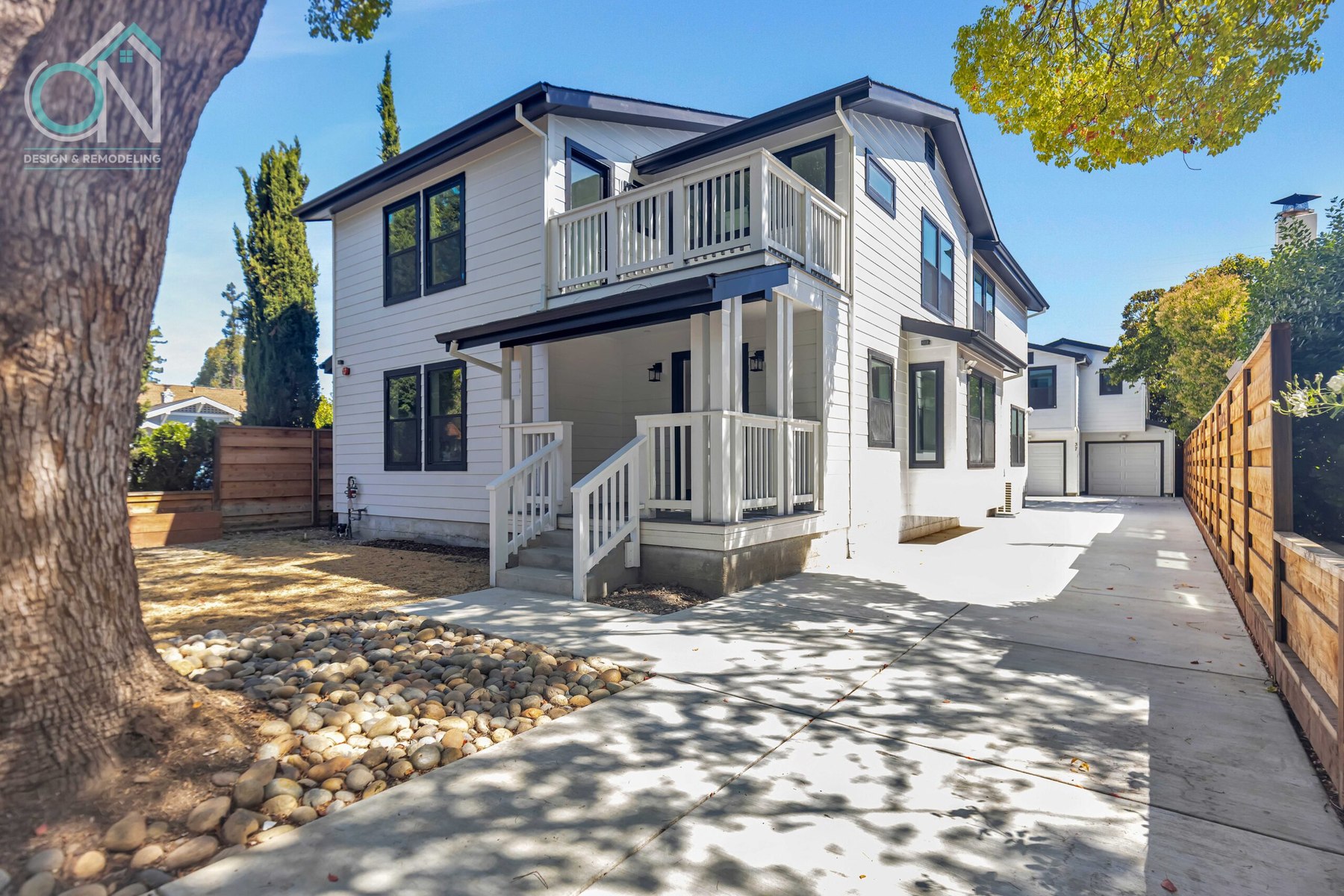
Adding an accessory dwelling unit is one of the most practical ways for Bay Area homeowners to create room for aging parents, adult children, a home office, or a long-term rental. But “ADU” is not one thing. California law and local codes recognize several types, and each one comes with different size limits, setbacks, and design trade-offs.
This guide walks through the four main options, what the rules say, and the questions that usually decide which one fits a given lot. For a broader look at ADU design, see our ADU design and build page.
The four main types of ADUs
San José’s ADU checklist groups units into four categories, and most Bay Area cities use the same structure because it follows state law:
- Detached ADU – a separate, stand-alone building, usually in the backyard.
- Attached ADU – new living space that shares a wall with the main house, or is built above an attached garage.
- Conversion ADU – an existing space (such as a garage, basement, or accessory structure) converted into a full unit.
- Junior ADU (JADU) – a smaller unit created inside the walls of the single-family home, including an attached garage.
Every ADU must have its own independent living facilities: a place to live, sleep, cook, eat, and a bathroom. A JADU has lighter requirements, covered below.
Detached ADU: the most privacy
A detached ADU is a true backyard cottage. It works well when you want separation between households, for example a rental tenant or a family member who values independence.
What the rules say:
- State law guarantees a detached new-construction ADU of at least 800 sq ft with four-foot side and rear setbacks, provided it meets the height limits (HCD 2025 ADU Handbook).
- In San José, the city standard for a detached ADU is up to 1,000 sq ft on lots under 9,000 sq ft, and up to 1,200 sq ft on lots over 9,000 sq ft. Side and rear setbacks are 4 ft, and the city lists rules such as a maximum of 40% rear-yard coverage and 6 ft of separation between buildings (San José ADU Universal Checklist).
- Height limits depend on the path you use. State standards allow 16 ft for a detached unit, while San José’s city standards list 18 ft for one story and 25 ft for a two-story detached ADU.
Think about: backyard space, access for construction, and how far the unit sits from the existing water, sewer, gas, and electrical connections. Long utility runs are often what makes one backyard location more practical than another.
Attached ADU: shared structure, separate home
An attached ADU shares a wall with the main house or sits above an attached garage. It can use space more efficiently on narrower lots and may simplify some utility connections, because the unit is next to the existing systems.
What the rules say:
- In San José, an attached ADU may be up to 50% of the main home’s living area, with a cap of 1,000 sq ft on lots under 9,000 sq ft and 1,200 sq ft on larger lots. The front door must be on a different facade than the main house (San José ADU Universal Checklist).
- State standards allow an attached ADU up to 25 ft tall, with 4 ft side and rear setbacks.
Think about: an attached unit ties into the existing house, so the condition of the older structure matters. Foundations, framing, and the roof tie-in should be reviewed early in design, especially in older Bay Area homes. Our room addition permit guide covers similar structural and permit steps.
Garage conversion ADU: reuse what you already have
Converting an attached or detached garage into a full ADU is often the most direct way to add a unit, because the footprint and much of the structure already exist.
What the rules say:
- No setbacks can be required for an ADU created within an existing living area or accessory structure (HCD 2025 ADU Handbook, Gov. Code § 66314).
- San José lists no parking requirement for ADUs, and state law does not allow cities to require replacement parking when a garage is converted (HCD 2025 ADU Handbook; San José ADU Universal Checklist).
- An ADU created from an existing accessory structure may add up to 150 sq ft beyond the existing dimensions for ingress and egress (Gov. Code § 66323).
Think about: many garages need work before they meet living-space standards, such as the slab, insulation, windows, ceiling height, and energy code compliance. If an earlier owner converted the garage without a permit, that needs to be addressed first. Learn more on our additions and ADU page.
Junior ADU (JADU): the smallest footprint
A JADU is created inside the existing single-family home, for example by converting a bedroom suite or an attached garage. It is a good fit when you want a semi-independent space for a family member without building new square footage.
What the rules say (HCD 2025 ADU Handbook):
- Up to 500 sq ft, and it must be within the walls of the single-family residence (an attached garage counts). JADUs are not allowed in detached accessory structures.
- It must include an efficiency kitchen. It may share a bathroom with the main house; if it does not have its own bathroom, it must have an interior entrance to the main living area.
- Owner-occupancy is required: the owner must live in either the JADU or the main house. Regular ADUs have no owner-occupancy requirement.
- No parking can be required, even when the JADU is converted from an attached garage.
Think about: because owner-occupancy is required, a JADU suits owners who plan to stay in the home. If you may rent both the house and the unit in the future, a standard ADU gives you more flexibility.
Quick comparison
| Detached ADU | Attached ADU | Garage conversion | JADU | |
|---|---|---|---|---|
| Where it goes | Separate backyard building | Shares a wall with the house or above an attached garage | Existing garage or accessory structure | Inside the existing home |
| Max size (San José) | 1,000 sq ft (lots <9,000 sq ft) / 1,200 sq ft (lots >9,000 sq ft) | 50% of main home, up to 1,000 / 1,200 sq ft | Existing space (state conversion path) | 500 sq ft |
| Side / rear setbacks | 4 ft | 4 ft | None required for existing space | None for existing space |
| Owner-occupancy | Not required | Not required | Not required | Required |
| Privacy | Highest | Moderate | Moderate to high | Lowest |
Rules change and vary by city, so always confirm current standards with your city before you design (see the San José ADU FAQs).
How to choose: five questions to ask
- Who will live there? A tenant or independent adult often favors a detached unit. A parent who wants to be close may be happier in an attached ADU or JADU.
- How much yard do you want to keep? A conversion or JADU keeps the yard. A detached unit uses it.
- What existing space do you have? A sound garage or underused wing can be the fastest path to a unit.
- Where are the utilities? Sewer, water, and electrical capacity can steer the location and type. Some projects also need an electrical panel or service upgrade.
- What are your long-term plans? If you may move out and rent both spaces, avoid the JADU owner-occupancy requirement.
Costs vary widely by type, size, and site conditions. For more detail, see our Bay Area ADU cost guide and our post on whether ADUs increase home value.
Permits and approval
State law requires cities to act on a complete ADU or JADU application within 60 days. Every ADU type still needs a full set of plans, and site-specific details, such as easements, trees, or flood zones, can affect what you can build. Our Bay Area planning and permits guide explains the process in more detail.
ON Design & Remodeling designs and builds ADUs across the South Bay and Peninsula, including Sunnyvale and Santa Clara, and our team handles design, engineering, and permits. For more ideas, read Maximize Your Space with a Custom ADU.
FAQ
What is the difference between an ADU and a JADU?
A JADU is up to 500 sq ft, must be inside the existing single-family home, and requires the owner to live on the property. A standard ADU can be attached, detached, or converted, can be larger, and has no owner-occupancy requirement.
Can I convert my garage into an ADU in San José?
Yes. Garage conversions are one of the ADU types San José recognizes, and the city lists no parking requirement for ADUs. The space must meet building, fire, and energy code standards for living space.
How big can a detached ADU be in San José?
Under the city’s standards, up to 1,000 sq ft on lots under 9,000 sq ft and up to 1,200 sq ft on lots over 9,000 sq ft, with 4 ft side and rear setbacks. Check the city’s current checklist before you design.
Do I have to live on the property if I build an ADU?
No for a standard ADU. State law does not allow cities to require owner-occupancy for ADUs. Yes for a JADU: the owner must live in either the JADU or the main home.
Can I have both an ADU and a JADU?
State law allows a single-family lot to combine an ADU with a JADU in many cases. The exact combination depends on your lot and your city’s ordinance, so confirm it during the feasibility stage.
Ready to find the right ADU for your lot? Contact ON Design & Remodeling to discuss your property and goals.